
With the salt spray corrosion test we are able to predict the effects that external agents will exert on a surface and its coating. With this test we are able to make sure that the quality of a given metal item, with or without anti-corrosion protection, is maintained.
Any item of a metallic nature that has to operate in the open air is subject to the action of external agents and to oxidation. Whether it is earth-moving machinery, cars, automatic gates or garden furniture components, everything must be adequately protected to prevent these agents from affecting its life cycle.
The first thought that comes to mind probably concerns rain, but in reality any atmospheric agent is a potential risk: the sun, the air, snow, ice, salt and time itself, understood as the years a given asset spends outdoors, just to name a few, can compromise metal surfaces.
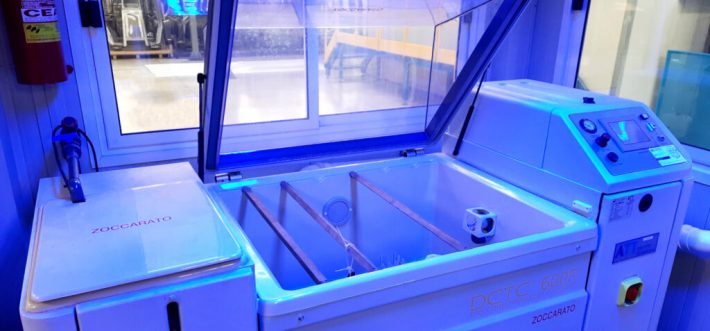
Salt spray test: the international standards
It is for this reason that carrying out preliminary tests can help to drastically reduce the component of unpredictability linked to the durability and resistance of the paint of a manufactured product under certain atmospheric conditions and risk agents.
In this regard, one of the most performed and reliable tests is called the salt spray corrosion test (NSS, Neutral Salt Spray), or more simply the salt spray test or accelerated ageing test, and it is a process used in the quality control processes of painted materials and is governed by precise European and international ISO standards.
The reference standards for the correct execution of the test are ISO 9227:2017 and ASTM B117.
How the test is carried out
Salt spray checks are suitable for making sure that the quality of a given metal material, with or without anti-corrosion protection, is maintained.
One of the greatest concerns of those who produce and deal with the quality control of materials is time, and this specific type of test is very useful for simulating the real life cycle of a product in order to prove its deterioration in external environments.
From an operational point of view, the salt spray test is carried out by placing the material to be tested in a special chamber, where a saline solution (5% NaCl) is sprayed at a temperature of 35°C.

In this way the material in question undergoes the same (possible) alterations that it would undergo if exposed to the air for a very long time, allowing its reactions to be checked in a short time.
The residence times in the chamber vary depending on the test required and, once completed, it will be able to give whoever requests it a general picture of the corrosion performance of their manufactured product.