
The cross-cut test is a very effective test to verify the compactness and adhesion of the existing paint. It is very useful in order to avoid starting to paint a surface with poor adhesion, and it will avoid having to redo a job because it was not carefully assessed in the initial phase.
Carrying out tests, samples and checks before undertaking any work related to the painting of metal and plastic is essential to understand the potential outcome, so as to be able to propose the best possible solution while always knowing precisely what to expect from a specific type of treatment.
Let us always remember that paint is not always and only an aesthetic parameter; it is often also an important factor against corrosion, oxidation and the action of other external agents that could limit the life cycle of a manufactured product, such as water and sun.
In the case in question, it is important to understand whether the paint is adhering perfectly to the surface or whether problems might instead arise, even if at a first superficial assessment everything appears to have been done in the best way.
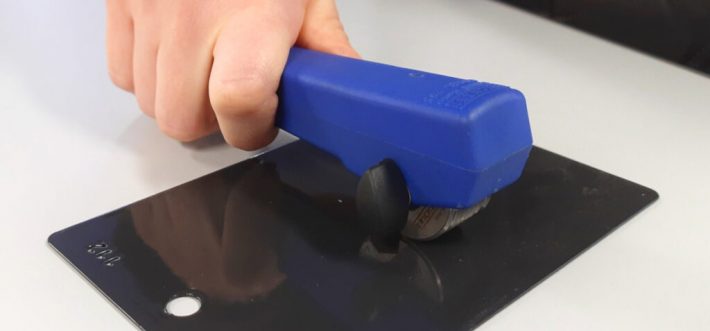
A very effective test to verify the compactness and adhesion of the existing paint consists in making, on the surface concerned, various incisions spaced a couple of millimetres apart from each other. These incisions must be deep enough to directly touch the surface beneath the layer of paint.
With the help of a cross-cutter, also called a crosshatch tester or adhesion tester, it is necessary to form a grid through a series of horizontal and vertical incisions, creating squares measuring 1x1mm, 2x2mm or 3x3mm.
After making the incisions, it will be enough to place on the area concerned some adhesive tape of the Permacel or 3M type (specifically designed for cross-cut tests).
If, when removing the tape, part of the paint remains attached to the adhesive, it means that the adhesion is poor and, therefore, applying a further coat of paint over it could certainly cause it to detach.
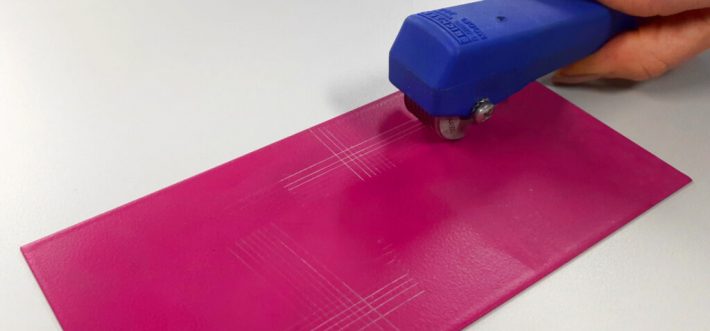
This check, called the cross-cut test or adhesion test, is a quick and simple system to assess the adhesion of coating systems; it is very useful in order to avoid starting to paint a surface with poor adhesion, and it will avoid having to redo a job because it was not carefully assessed in the initial phase.
If the grid that has been created is completely flat, with the edges of the lines perfectly clean, it will mean that the paint is suitable and it will be possible, where required, to apply a further coating layer on top of the current one (this is the case with an ISO 0 value).
If, on the contrary, the edges of the lines are not clean, but there are detachments of paint at the corners or along the various lines, it means that the treatment is not perfectly adherent to the surface.
In this case it will be necessary to assess the level of severity of the situation, with an ISO value that can range from 1 to 5, where 1 represents small detachments at the intersections of the lines (equal to no more than 5% of the tested area) and 5 a level of detachment greater than 65% of the area, a situation absolutely not compatible with a painting requirement and which will require a complete scraping of the current surface before it can be processed further.
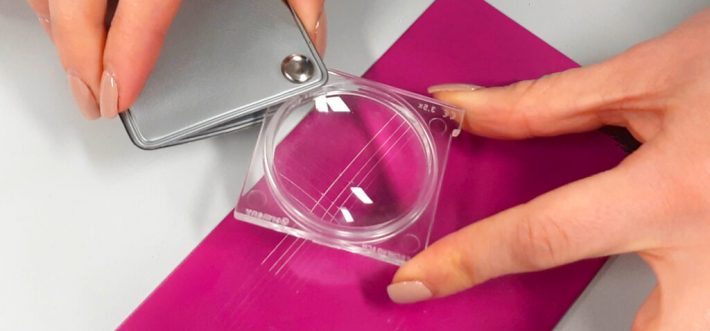
The reference standard that governs this test is ISO 2409:2020, where the test method is clearly defined, with indications that illustrate in detail how to carry out the check properly.
Our in-house laboratory is perfectly capable of carrying out the test, with expert technicians who can perform it in a short time and reveal its outcome in complete safety.
The cross-cut test is one of the simplest and most practical methods to understand whether the adhesion of a coating is optimal or not, on both metal and plastic substrates, and for this reason its use is strongly recommended.