
The gloss measurement test of the paint examines the degree of shine reached by the surface coating, through an instrument capable of detecting data at different angles.
Gloss is one of the main aesthetic characteristics of surface coatings, on a par with colour itself. For this reason the gloss measurement test of the paint is essential to evaluate the appearance of a surface-coated item.
Through a special instrument, called a gloss meter, it is possible to identify the degree of shine reached by the paint, in order to understand whether it meets expectations.
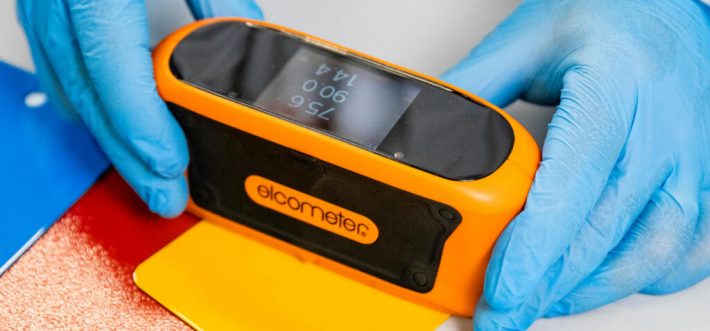
It must be considered that the visual appearance can determine people's perception of a product, and that this perception is subjective. To get around this “personal” component, one of the measurement parameters used to define and quantify the overall visual quality of a product is gloss. For this reason it is essential to evaluate it with safe, standardised and easily repeatable tests.
Gloss is measured by aiming a beam of light of constant intensity, at a fixed angle, at the surface to be evaluated and then monitoring the amount of light reflected from the same angle. This specular reflectance is measured using the aforementioned gloss meter. It must be borne in mind that different surfaces require different reflection angles.
Gloss is classified as matt, semi-gloss or gloss, and the unit of measurement that governs it is called Gloss Units (GU).
The process involves detecting 3 different angles of reflectance, at 20, 60 and 85 degrees.
The standard that governs this test is ISO 2813.