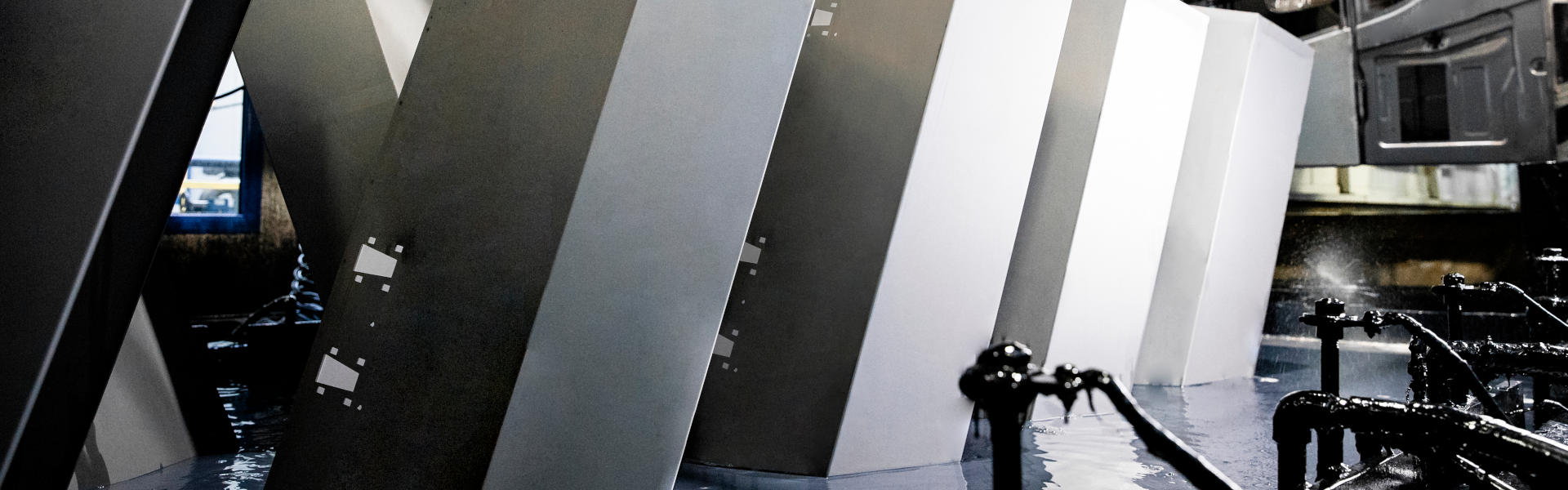
Cataphoresis painting: what it is and how it works
Contact usAfter having talked several times about cataphoresis treatment, the time has come to go a little deeper with the issue, to explain in detail what it consists of from a more technical and specific point of view.
In these pages we have spoken and mentioned cataphoresis treatment several times, its importance and why we recommend its use in improving the protection of articles from the action of corrosion. It is one of the main treatments that we can offer to our customers and our dedicated plant is among the largest in Europe. Now the time has come to go a little deeper, to explain in detail what cataphoresis consists of from a more technical and specific point of view.
The chemical-physical principle underlying cataphoresis
The phenomenon underlying this process is called electrophoresis: by introducing two electrodes into a special tank, between which a potential difference is applied, the particles of the colloid that make up the liquid contained in the tank are set in motion thanks to the electric field that is generated, all directing themselves towards one of the two electrodes. In the case in which the polarity is directed towards the cathode, it is called a cataphoresis process, in the case in which it is directed towards the anode, it is called of anaphoresis process (a practice now disused, superseded by cataphoresis).
If this is the phenomenon that sets the particles in motion, there are others that take part in the spreading of the coating: these are mechanical transport, electrolysis, electro-osmosis and electrocoagulation.
Mechanical transport: it is guaranteed by the electric charge supplied to the bath, which keeps the particles that compose it agitated.
Electrolysis: it is a process that leads to chemical transformations thanks to the supply of electrical energy; thanks to this phenomenon the following reaction is carried out at the cathode (i.e. the piece to be painted): 4H2O + 4e– → 2H2 + 4OH–.
Electro-osmosis: consists in the migration of the liquid contained in the bath and in which the particles were previously present, outside the film deposited on the coating; it turns out to be of great importance in the subsequent rinsing phase of the product, as thanks to this process the percentage of liquid will be extremely low.
Electrocoagulation: it is a key moment, in which the particles that make up the bath are deposited on the surface to be coated. To best control this phase it is necessary to find the right balance between timing, voltage, current, temperature, pH.
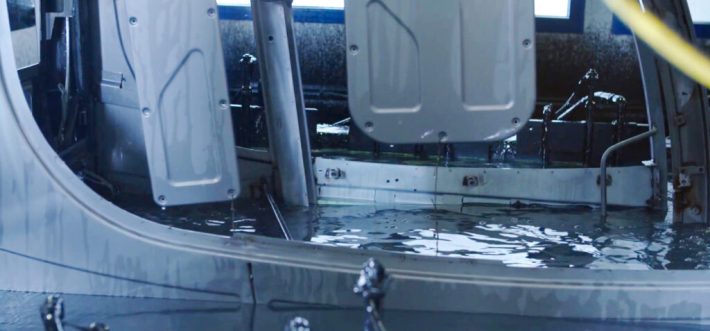
The phases that make up the cataphoresis treatment
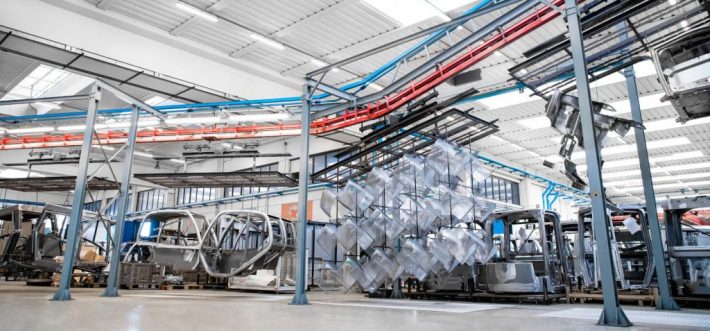
We have seen what the chemical and physical principles that animate this process are, now let's see in detail the phases with which it is carried out and defined within our factory, which can count on one of the largest cataphoresis painting systems in Europe. The entire process, which has 11 sequential phases, can be divided into three macro-steps consisting of cleaning, pre-treatment and actual cataphoresis.
Cleaning
Before starting with the cataphoresis treatment, the items must be adequately prepared, cleaned and prepared to receive the coating. All this begins with the cleaning phase and specifically with the alkaline degreasing treatment.
Here the artefacts are first immersed and subsequently "rinsed" with an alkaline solution specifically designed to eliminate oily or ferrous residues from the surface deriving from the carpentry activity which led to the creation of the raw material that will be treated.
The moment dedicated to cleaning is then completed with several rinsing phases with mains water, at the end of which the articles can move on to pre-treatment.
Pretreatment
The pre-treatment process is equally important, because it allows the articles to be prepared to receive the subsequent cataphoresis painting in the best possible conditions.
Here the activation and phosphating phenomena with zinc salts occur, a first step in protecting the article. Here the zinc salt crystals are deposited on the surface of the metal pieces to be treated, already giving them a first level of protection from corrosion and rust.
This is followed by the fundamental demi and passivation steps: with the first, salts are removed from the raw water using filters and any bacteria that could corrupt the treatment are eliminated via UV rays, while the second consists of an additional layer of protection that is applied to the pre-treatment exposed so far.
Cataphoresis
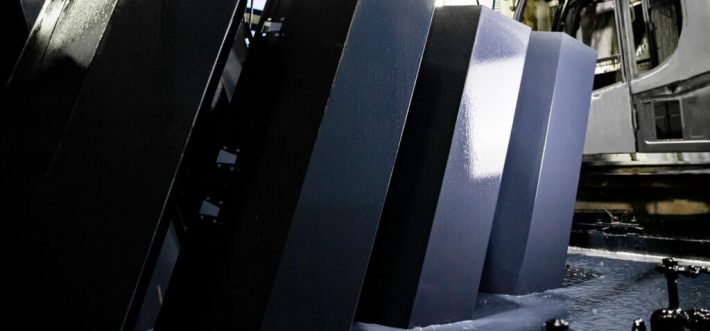
At this point the article is ready to be treated in cataphoresis: as anticipated, it is a coating applied by electrodeposition in an immersion tank composed of resin, pigments, fillers and solvents, where a series of physical-chemical phenomena lead the coating to deposit on the substrate.
Once out of the tank, the items are rinsed with the ultrafiltrate: this is the liquid part of the bath, from which the pigmentation is removed, which is extracted with special equipment similar to those for reverse osmosis.
Ultrafiltration allows a series of benefits such as the recovery of paint, the control of the chemical parameters of the bath, the constant maintenance of conductivity. Now, after a further rinsing moment, the articles are ready to enter the cooking oven, which will deposit and definitively polymerize the paint.
Our plant is completely automated and controlled remotely by specialized technicians: this allows us to best standardize production and organize it as needed.
Why choose cataphoresis
Cataphoresis provides extreme protection from corrosion, external agents and chemical agents, for this reason it is widely used in demanding sectors such as automotive, motorbike, the agricultural sector, industrial machinery, liquid management, heating and refrigeration, furniture. These are sectors where the articles are often in contact with agents and substances that could corrupt the metal articles, leading them to rust: cataphoresis simply prevents this from happening, significantly extending the life cycle of the product and combining these characteristics with an optimal aesthetic appearance.
In addition to this benefit, note that it is the only process that guarantees complete coverage of the items, even in the corners, edges and smallest cavities.
More articles

E-coating or Powder Coating? 3 Factors to Consider Before Choosing
Why does metal corrode? The 7 factors not to be underestimated
Metal cabinets for data centers in a marine environment: why the C5-H cycle is fundamental
Cataphoresis: the questions you didn't know you had (and the answers that make the difference)
Have a project in mind?
Tell us about your needs: our team will guide you to the most suitable treatment.
Contact us