E-coating or Powder Coating? 3 Factors to Consider Before Choosing
Contact usWhen specifying the surface treatment for a metal component, one of the most common questions is: is e-coating or powder coating the better choice?
The answer depends on what you need the coating to achieve.
Corrosion protection, exposure to weather, component geometry, appearance and long-term durability can all influence the choice between the two treatments. In some cases, the best solution is to use e-coating and powder coating together in the same coating system.
Let’s take a look at the main factors to consider.
E-coating and Powder Coating: What Are the Differences?
Let’s start with how each process works.
E-coating, also known as cathodic electrodeposition coating or electrophoretic coating, is an immersion coating process. The component is fully immersed in a bath containing a water-based paint emulsion, and the coating is deposited through an electrochemical process.
One of its main advantages is its ability to produce a uniform coating, even on components with complex geometries and in areas that are difficult to reach with conventional application methods.
Powder coating, on the other hand, involves applying powder electrostatically to the component’s surface, followed by curing in an oven.
It is an extremely versatile process, used across many industrial sectors and particularly suitable when colour, surface finish and appearance are important alongside component protection.
Neither treatment is universally better. The right choice depends on the component’s characteristics and the conditions in which it will operate.
How Complex Is the Component’s Geometry?
The component’s shape is one of the first factors to assess.
On simple, easily accessible surfaces, powder coating can deliver excellent results in terms of both protection and appearance.
The situation changes when a component has more complex features: recesses, internal corners, welds, cavities or areas that are difficult to reach.
In powder coating, the electrostatic field can make powder deposition more difficult in certain areas. This is particularly noticeable in deep cavities and internal corners, where the Faraday cage effect can occur.
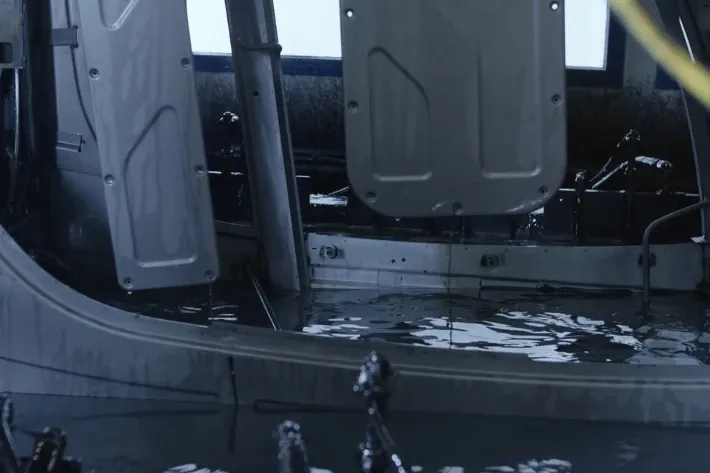
E-coating works differently: the component is fully immersed in the treatment bath. This allows the process to coat surfaces and geometries that would be more difficult to reach using conventional application methods, with a particularly uniform finish.
For complex components, frames and fabricated metal assemblies with numerous hard-to-reach areas, this can be a significant advantage.
The first factor to consider is therefore geometry. The more complex the component, the more important it becomes to determine whether the selected process can provide adequate coverage in critical areas.
Where Will the Component Be Used?
A component intended for use indoors in a controlled environment has very different requirements from one installed outdoors or regularly exposed to water, humidity, condensation and weather.
That is why, before discussing colour or finish, it is essential to understand the component’s operating environment.
When a high level of corrosion protection is required, e-coating is a particularly effective solution thanks to the uniformity and adhesion of its protective film.
This is one of the reasons why the treatment has long been used in industries where corrosion resistance is a key requirement.
Powder coating can also deliver excellent performance, especially when combined with appropriate surface pretreatment. However, the coating system must be selected with the component’s actual service conditions in mind.
For particularly demanding requirements, another solution may be worth considering: e-coating + powder coating.
In this system, e-coating acts as a protective primer, while powder coating adds a further layer of protection and provides the desired appearance.
How Important Is Appearance?
Not all metal components have the same aesthetic requirements.
For some parts, corrosion resistance is the overriding priority. For others, colour and finish are an integral part of the final product.
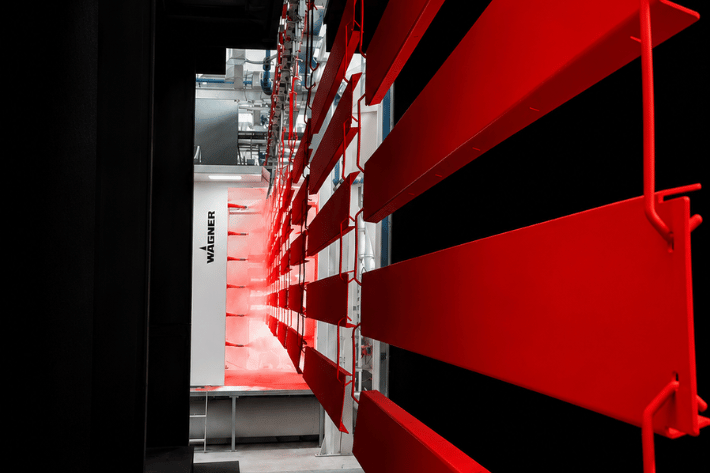
When a project calls for a specific RAL colour, different gloss levels or particular surface effects, powder coating offers considerably greater flexibility.
A wide range of colours and gloss, matt, smooth or textured finishes makes it possible to tailor the coating to the component’s aesthetic and functional requirements.
E-coating, by contrast, is primarily chosen for protection. Its colour range is more limited, and the treatment is mainly selected for its functional properties.
The question is therefore straightforward: does the coating primarily need to protect the component, or must it also define its final appearance?
In the latter case, powder coating, either on its own or applied over an e-coat layer, offers a much wider range of possibilities.
E-coating and Powder Coating Together: When Does It Make Sense?
Treating the two processes as competing alternatives can be misleading.
In many industrial applications, e-coating and powder coating are complementary.
A coating system consisting of e-coating followed by powder coating combines the strengths of both processes: a uniform primer that is particularly effective at protecting against corrosion, together with a durable, customisable finish that also meets the product’s aesthetic requirements.
This solution is used particularly for components exposed to demanding environmental conditions, or when a project requires both high corrosion protection and a specific aesthetic finish.
The choice must, of course, be assessed on a case-by-case basis, taking into account the material, geometry, surface preparation, operating environment and required performance.
E-coating or Powder Coating: Which Should You Choose?
The decision can therefore be approached through three questions:
- Does the component have complex geometries or hard-to-reach areas?
- What environmental conditions will it be exposed to during its service life?
- How important are colour and surface finish compared with corrosion protection?
The answers can already help narrow down the options considerably.
But there is one final point to bear in mind: a surface treatment should not be selected in isolation.
The component’s material, surface condition, pretreatment, required coating thickness, service conditions and customer specifications all contribute to the final result. Two seemingly similar parts may therefore require completely different coating systems.
For this reason, particularly when high corrosion resistance is required, it is helpful to assess the coating system during the component’s design or production planning stage.
Do You Have a Component That Needs Coating?
At Zoccarato Industrial Coatings, we work with e-coating, powder coating and combined coating systems every day, assessing each treatment according to the component’s characteristics and required performance.
If you have a new project, a technical drawing or a component for which you need to specify a coating system, contact us.
Together, we can review the material, geometry, operating environment and resistance requirements to identify the most suitable treatment.
More articles
Why does metal corrode? The 7 factors not to be underestimated
Metal cabinets for data centers in a marine environment: why the C5-H cycle is fundamental
Cataphoresis: the questions you didn't know you had (and the answers that make the difference)
Industrial painting for agricultural machinery: protection against wear and corrosion
Have a project in mind?
Tell us about your needs: our team will guide you to the most suitable treatment.
Contact us