Why does metal corrode? The 7 factors not to be underestimated
Contact usMetal corrosion is not a random phenomenon. It is a predictable, measurable and above all preventable electrochemical process. Yet, in industrial practice, many of the factors that cause corrosion are underestimated during the design phase, choice of materials or definition of the painting cycle.
Understanding the causes of corrosion of steel and other metals means reducing maintenance costs, production stops, complaints and premature replacements.
Let's see the 7 main corrosion triggers that every technical office and industrial buyer should consider.
1. Humidity and water, the real trigger of corrosion
Electrochemical corrosion requires an electrolyte. In most cases this electrolyte is simply water.
Typical situations are heavy rain, nighttime condensation, relative humidity above 60 percent, stagnant water in cavities and crevices.
Even in the absence of obvious wetting, surface condensation alone is sufficient to activate the oxidation process of the metal. For this reason, in external or industrial environments, the choice of the correct anti-corrosion cycle is crucial.
2. Oxygen, the fuel of oxidation
Oxygen is an integral part of the chemical reaction that leads to the formation of rust.
Metal, oxygen and water generate iron oxides.
The greater the availability of oxygen, the greater the speed of the reaction. In ventilated environments or structures exposed to the outside, the process is continuous and progressive. This is why metal corrosion protection must create a stable and continuous barrier between metal and atmosphere.
3. Salts and chlorides, invisible corrosion accelerators
Chlorides represent one of the main factors in accelerated metal corrosion.
They are found in marine environments classified C5 according to ISO 12944, on roads treated with de-icing salts and in chemical industrial plants.
Salts increase the conductivity of water, break the protective films and trigger pinpoint corrosion phenomena, called pitting. In these contexts it is necessary to provide high resistance cycles, C4, C5-H or C5-M, with adequate surface preparations and thicknesses.
4. Air pollutants and aggressive industrial environments
In some industrial areas corrosion can be more aggressive than in marine areas.
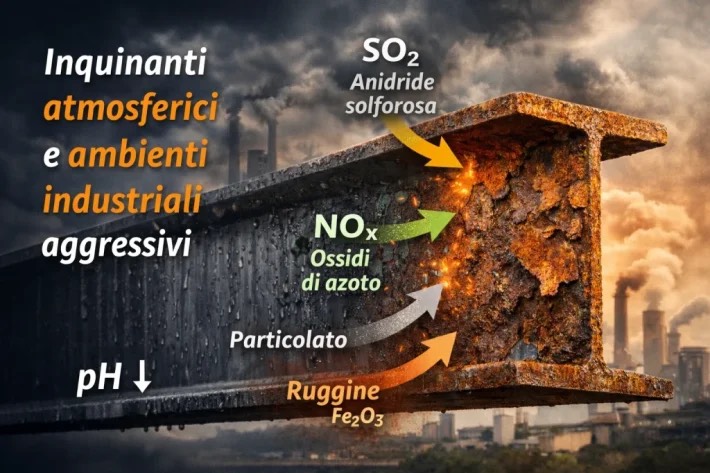
Critical agents such as sulfur dioxide, nitrogen oxides and particulate matter lower the pH of surface moisture and accelerate the corrosive reaction. In these environments the ISO classification often falls into the C4 or C5 categories.
The evaluation of the exposure environment is therefore the first step to define a correct industrial anti-corrosion protection strategy.
5. Contact between different metals, galvanic corrosion
When two metals with different electrochemical potential are in contact in the presence of humidity, a galvanic couple is generated. The less noble metal oxidizes more quickly.
This is the typical case of carbon steel in contact with galvanized surfaces, aluminum or stainless steel. During the design phase, it is essential to isolate the materials, provide specific protections and evaluate electrochemical compatibility.
Galvanic corrosion is often a design problem even before a painting problem.
6. Design errors and critical construction details
Corrosion often starts in the details.
Sharp edges that are not rounded, closed cavities without drainage, inadequately prepared welds and non-uniform thicknesses of the coating compromise the effectiveness of the protection.
The technical standards recommend minimum radii on the edges to guarantee correct adhesion of the covering. Effective corrosion protection begins already at the component design stage.
7. Mechanical damage to the coating
Corrosion almost always starts from the weakest point of the protective system.
Scratches, impacts during assembly, abrasions and micro-cracks in the film create discontinuities in the protective coating. Even a small defect can become the trigger point for sub-film corrosion.
It's not just the thickness of the film that counts, but the continuity and homogeneity of the surface treatment.
The role of cataphoresis in anti-corrosion protection
Among the most effective technologies for the anti-corrosion protection of metal in the industrial sector is cataphoresis.
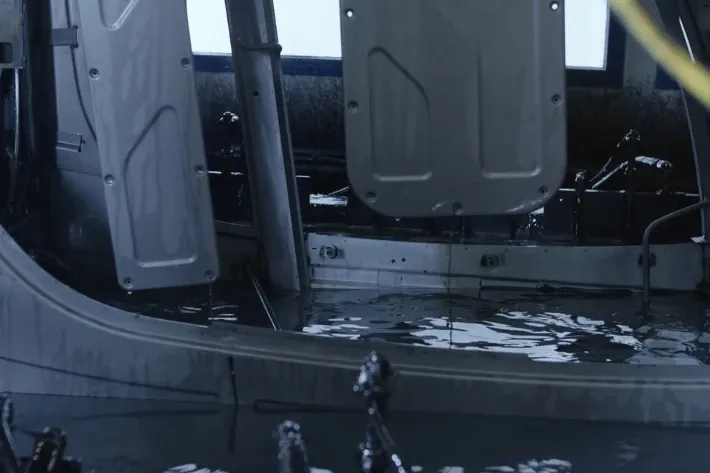
Cataphoresis is an electrophoretic painting process in which the product immersed in an aqueous bath is uniformly coated thanks to an electric field. The controlled deposit allows obtaining a homogeneous thickness even on complex geometries, internal cavities and edges that are difficult to protect with traditional systems.
From a technical point of view, cataphoresis guarantees:
- High film uniformity
- Excellent adhesion to the metal substrate
- Complete coverage even in internal areas
- Corrosion resistance compliant with ISO environmental classes
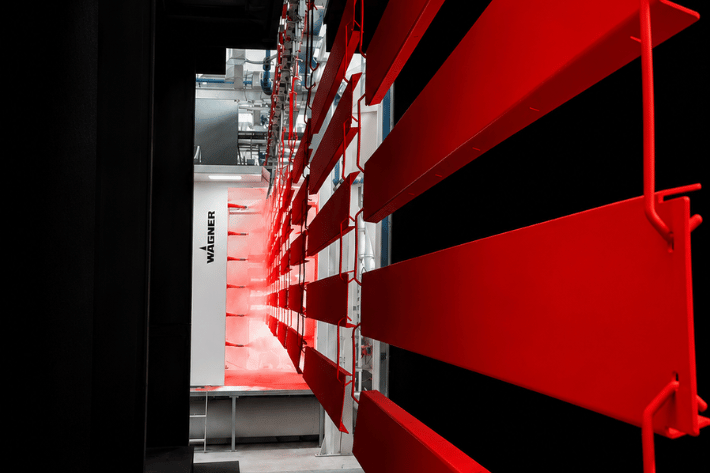
In combination with powder or liquid painting, cataphoresis represents a structural solution for C4, C5-H and C5-M cycles, increasing the durability of the product and reducing the total operating cost over time.
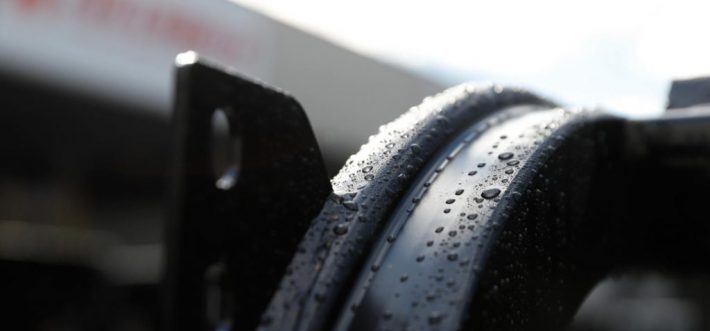
Metal corrosion, prevention is cheaper than restoration
Intervening after the appearance of rust means stopping production, carrying out sandblasting and restoration, incurring extraordinary maintenance costs and managing possible disputes.
Correct industrial anti-corrosion treatment, based on analysis of the environment, adequate surface preparation and choice of the correct protective cycle, allows you to increase the durability of the product, reduce the Total Cost of Ownership and guarantee regulatory compliance.
Conclusion
The question is not whether the metal will corrode. The real question is when and how quickly.
Knowing the factors that cause metal corrosion allows you to design consciously, choose the correct protection cycle and guarantee long-term performance.
Because corrosion is not just an aesthetic problem. It is a structural, economic and reputational problem.
More articles

E-coating or Powder Coating? 3 Factors to Consider Before Choosing
Metal cabinets for data centers in a marine environment: why the C5-H cycle is fundamental
Cataphoresis: the questions you didn't know you had (and the answers that make the difference)
Industrial painting for agricultural machinery: protection against wear and corrosion
Have a project in mind?
Tell us about your needs: our team will guide you to the most suitable treatment.
Contact us