Powder or liquid painting: which to choose?
Contact usThe first approach to the world of industrial painting also involves understanding one of the major differences in the sector: what differences are there between powder and liquid painting? When to choose one or the other? We try to clarify, illustrating the characteristics and peculiarities of the two painting processes.
Painting an item means refining it, improving it and protecting it. For this reason, choosing the most suitable painting cycle is essential to extend its life cycle and guarantee the qualities and specifications that make it suitable for the activity for which it was created.
Leaving aside the discussion related to cataphoresis or galvanizing, let's address one of the main choices that the sector offers: when to rely on powder coating and when on liquid painting? Why choose powder coating for certain items and liquid painting for others?
In the next lines we will try to answer these and other questions, clarifying the characteristics and differences of these two surface treatment technologies.
The characteristics of powder coating
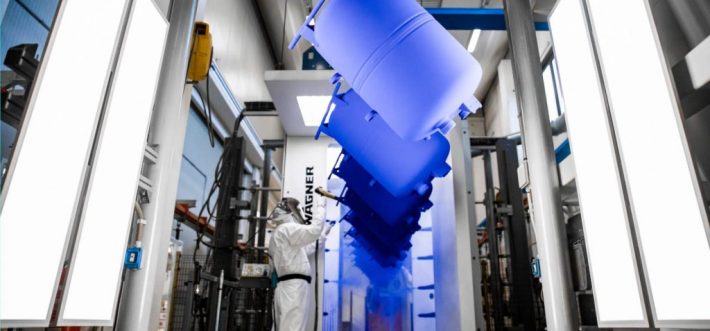
Powder coating is a consolidated standard in the field of industrial painting. To formulate these paints it is necessary to create binders, made through an extrusion process with which solid components are mixed and fused together, in which the pigments are then dispersed and finally mixing everything. The compound is then pulverized, so that the paint has an appropriate particle size distribution curve.
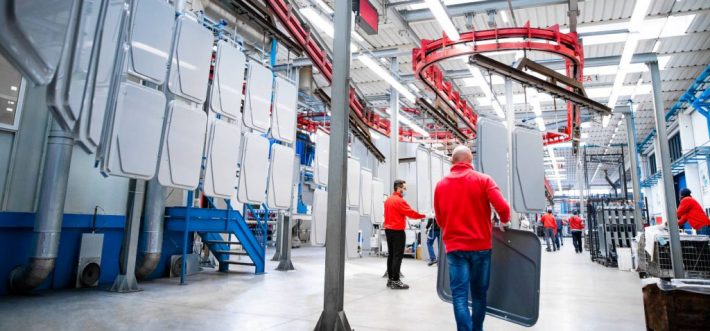
In the vast majority of cases, with powder coating the substrate is covered using manual and/or automatic electrostatic guns; the ultimate goal is to obtain a continuous and homogeneous film.
Once painted, the items enter the baking oven: here, even for relatively short times and at temperatures ranging between 180 and 200 degrees, the paint polymerizes and adheres permanently to the substrate.
Both thermosetting and plastic resins can be used for this type of painting, even if the former are largely the most used and widespread.
There are different classes of thermosetting resins used for powder coating, which can be cataloged into:
Epoxies
Hybrid
Polyester
Acrylics
UV radiation cure
We mentioned a little while ago that it is an electrostatic process, but how does it work?
The guns responsible for directing the flow of paint particles also have the task of electrostatically charging the powder itself, through a generator connected to the sprayer. The powder thus emitted by the guns will stick to the articles through the potential difference between the "target" and the powder itself. In this case, the article to be treated acts as a positive pole, while the paint powder acts as a negative pole.
Another factor of great importance, both productive and environmental, is that on the one hand this process does not require the use of solvents potentially harmful to the environment, on the other the various paint particles that do not adhere to the substrate are recovered and recycled, then inserting them again into the processing cycle. A limitation of waste that benefits the entire system.
The characteristics of liquid painting
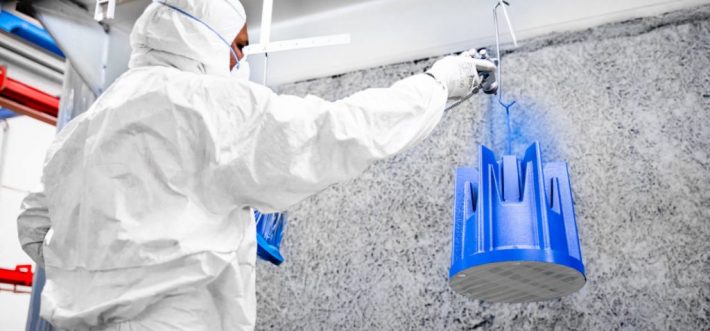
Liquid painting, also called spray, is a historically well-established type of surface treatment, which consists of reducing the coating liquid into more or less fine drops. There are various technologies that allow this result, including pneumatic, compressed air, mixed, electrostatic.
The substrate to be treated is hit by the miniaturized liquid through special guns, typically through an external conductor (compressed air). The role of the gun is precisely to divide the jet of paint into very fine droplets and deposit them on the article.
Note that it can be applied to both metallic and plastic articles.
As anticipated, there are different application techniques, to be evaluated based on the item to be painted. Among the main ones we find:
High pressure spraying (airless): with a sufficiently high pressure and a small gun nozzle, the paint is atomized. It is a technique used for articles that do not require excellent or perfect finishes, but which focus entirely on the adhesion of the coating to the substrate and. If used with precision, due to the high flow rate of the paint used, processing times are speeded up, as in a single coat a dense paint can be applied without the risk of dripping, which is deposited at low speed (therefore with less rebound). This also involves the use of a slightly diluted paint with less solvent vapor.
Mixed spraying (airmix): also called mixed-air spraying, it allows you to apply industrial paints producing minimal spray fog, maintaining excellent quality and a normal thickness of the coating. It is a patented technique under the name Airmix®. Starting from a high pressure spraying, we modified the paint gun, keeping the exit nozzle unchanged, but inserting a pair of small ears on the sides powered by compressed air.
Electrostatic spraying: this technique means that the guns used, in addition to pulverizing the paint into tiny droplets, charge the paint electrically and create an electric force field that causes the paint to adhere to the article to be treated. It is a method that reduces application time, but on the other hand also involves greater use of solvents and consequent pollution of the workplace.
Also in this case, after the painting phase, the items enter the oven: unlike powder coating, the cooking temperatures are lower and vary between 60 and 80 degrees.
Differences, advantages and disadvantages of powder coating and liquid coating
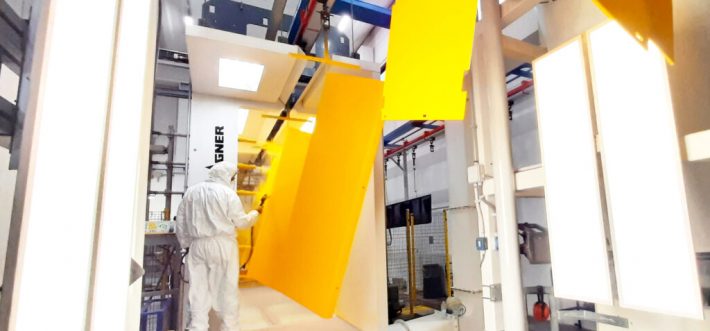
Some substantial differences have already emerged in the following lines, starting with the treatable items: where liquid painting can be applied to plastic or metal items, powder painting is reserved for metal items only. This is due to the temperatures reached by the cooking ovens, as we have seen the liquid operates within a range of 60-80 degrees, while for the powder it rises towards 180-200 degrees.
Let's see some of the most frequent advantages and disadvantages of these two surface treatments.
Advantages of powder coating:
It is more eco-sustainable, because it does not use solvents;
great ease of recovery and reuse of dust that falls and does not adhere to the substrate;
excellent coverage of the edges of the product;
absence of any dripping points due to vertical sliding of the covering;
low operating costs;
ease of control of the coating thickness;
Disadvantages of powder coating:
The color change is not immediate and must be changed throughout the entire production line;
can only be applied to metal articles.
As regards liquid painting, the pros and cons must be evaluated based on the application technique chosen. Let us therefore try to address the issue in a general way.
Advantages of liquid painting:
Historic and robust painting system;
possibility of adjustments, because it is possible to obtain even a very small flow rate;
usable for jobs that require little paint;
speed of execution.
Disadvantages of liquid painting:
If not performed perfectly, there is the risk of obtaining drips and bubbles;
lower costs than powder coating;
use of solvents and consequent pollution resulting from this;
to avoid impurities, the work environment must be perfectly clean.
Conclusions
Having reached the end of our overview, it is difficult to say which is the best industrial painting technique between the two examined: experience teaches us that the best thing is to examine case by case, necessity by necessity, before making a decision on which type of painting to choose and apply.
Some industrial sectors prefer one over the other, others still seek the combination of both to create optimal aesthetic and protective effects. The important thing is to carry out preliminary assessments, tests and painting trials, so as to know exactly which technique will lead to the desired result.
Do you want to receive more information? Write to us at info@zoccaratoverniciature.it.
More articles

E-coating or Powder Coating? 3 Factors to Consider Before Choosing
Why does metal corrode? The 7 factors not to be underestimated
Metal cabinets for data centers in a marine environment: why the C5-H cycle is fundamental
Cataphoresis: the questions you didn't know you had (and the answers that make the difference)
Have a project in mind?
Tell us about your needs: our team will guide you to the most suitable treatment.
Contact us