
Powder coating: what it is and how it works
Contact usPowder coating is a consolidated standard in the industrial painting sector, guaranteeing maximum treatment quality and low environmental impact. Let's take a deeper look at this process, how it works and what benefits it can bring.
Powder coating has experienced considerable development in recent decades, both technologically and in terms of application, making it one of the most used coating processes in the world. This is a process that can only be carried out on metal surfaces, which are covered with paint powder based on synthetic resins (such as epoxy powders), with both a decorative and protective purpose. Let's see in detail what this practice consists of, the elements that compose it and all the associated advantages.
Application of powder paint: electrostatic spray painting
For the application of powder paints there are 4 different techniques:
electrostatic spray painting;
fluidized bed painting;
electrostatic painting in fluidized bed;
flame-spray painting.
Among all these, the most common and consolidated is electrostatic spray painting: extremely flexible and versatile, it involves the use of specially designed guns, both for manual and automatic use.
The paint powder is contained in tanks, connected to the guns via tubes; here the powder is electrostatically charged and sprayed on the article to be coated using compressed air.
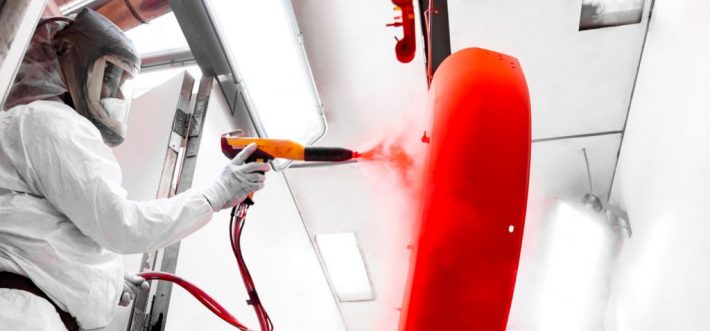
To ensure that the paint particles remain attached to the article to be coated, the electrostatic effect comes into play: these particles are subjected to a negative electric charge process, while the article to be treated on the surface is positively charged. The electric field that is created causes the paint to remain attached to the article.
The article covered in powder is at this point inserted into the cooking oven, where the paint polymerizes, depositing itself permanently on the substrate, covering it with a uniform film.
It is important to underline the role of the gun in this process: in addition to electrostatically charging the powder, it allows you to direct the paint towards the target, controlling the shape and density of the cloud that will be created.
Powder coating systems are generally composed of:
conveyor belts, which have the task of moving the items to be processed forward;
a washing and pre-treatment system for the products, for the optimal preparation of the piece for the subsequent deposition of the powder;
manual and/or automatic application booths for the deposition of the paint powder;
a polymerization oven.
The advantages of powder coating
A series of advantages characterize this application method, which can be summarized in:
possibility of recovering the powder that does not adhere to the substrate, which is thus reintroduced into the production cycle;
possibility to adjust the thickness of the film;
excellent coverage of edges and corners of the articles to be treated;
low operating costs;
the obtainable mechanical characteristics, such as hardness and elasticity, can be very high;
absence of problems due to the possible vertical dripping of the covering.
More articles

E-coating or Powder Coating? 3 Factors to Consider Before Choosing
Why does metal corrode? The 7 factors not to be underestimated
Metal cabinets for data centers in a marine environment: why the C5-H cycle is fundamental
Cataphoresis: the questions you didn't know you had (and the answers that make the difference)
Have a project in mind?
Tell us about your needs: our team will guide you to the most suitable treatment.
Contact us