Seeing into the future: the test for accelerated aging
Contact usThe accelerated aging test allows us to reproduce in the laboratory the damage that an item would suffer over months or years of exposure to sunlight, rain and dew, all in just a few days.
When we purchase something, whether privately or professionally, we always hope that it maintains its characteristics as much as possible. We hope that it remains aesthetically the same even after many years, that it does not suffer structural damage, that something does not compromise its functionality. In other words, long-lasting.
Very often, however, this remains a hope, because in many cases there is no way of knowing what will happen in a few years, if not by relying on personal experience, predictions and opinions, more or less truthful and reliable.
Fortunately, in the field of industrial painting, this aspect can be defined precisely, leaving little room for doubts and misunderstandings. It is something safe, of course, which in some ways reassures on some aspects related to superficial treatments. Let's find out what the Accelerated Weathering Test is and why it often proves to be fundamental in the decision-making and planning phases related to painting.
“Seeing into the future” is perhaps the most apt expression to describe how the test works.
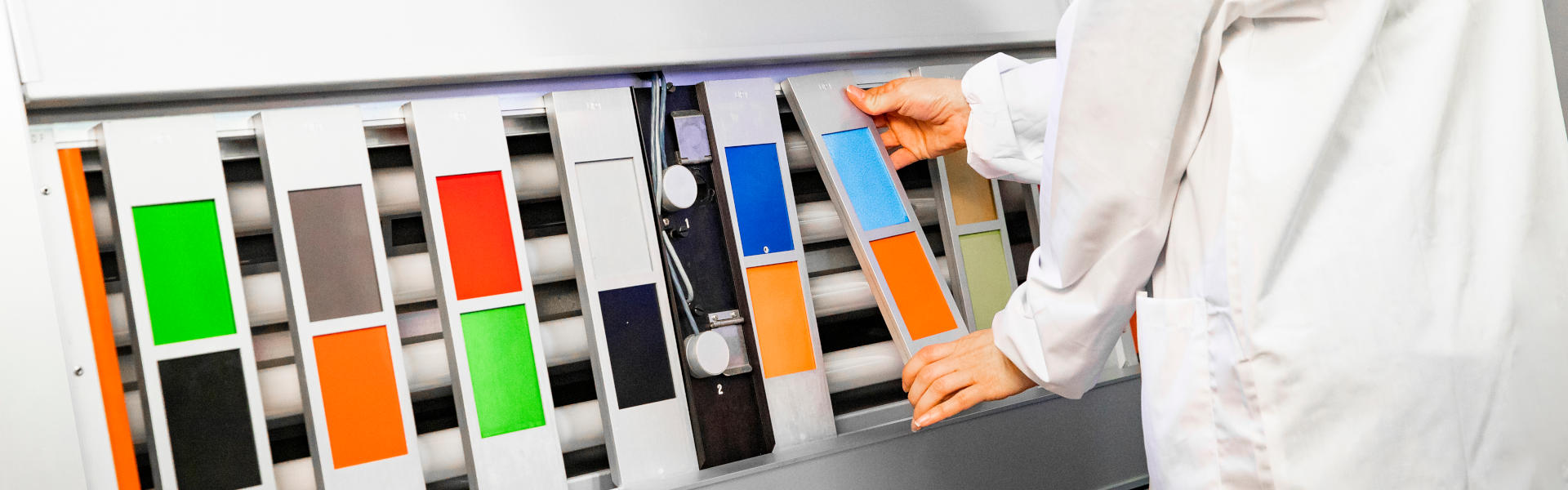
The accelerated aging test allows us to reproduce in the laboratory the damage that an item would suffer over months or years of exposure to sunlight, rain and dew, all in just a few days.
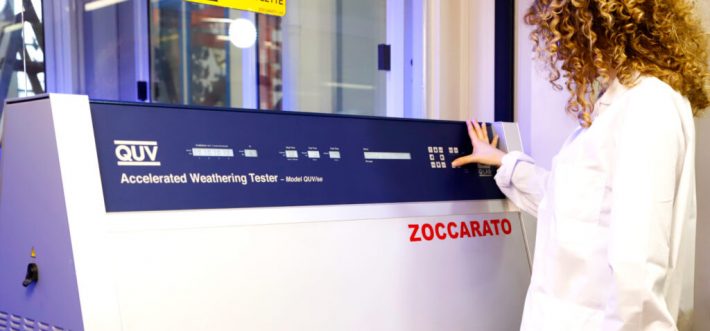
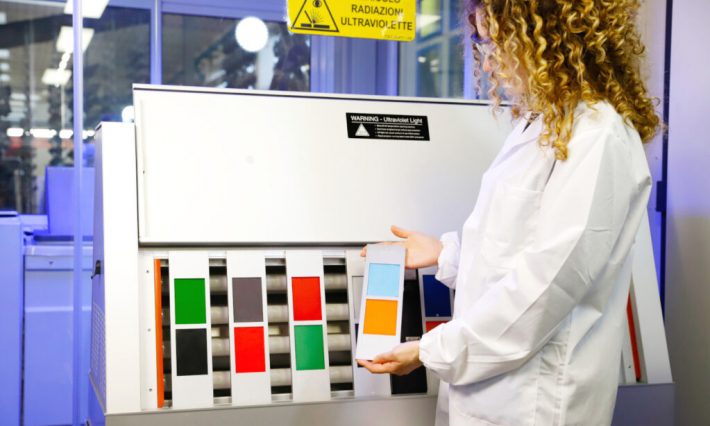
This is an aging simulation with which a special instrument subjects the chosen materials to alternating cycles of radiation with special UV lamps and humidity, as well as to controlled high temperatures. It is an extremely useful test for understanding the resistance of a surface treatment to time and external agents, to evaluate its effectiveness in the long term.
One of the most interesting aspects of this test is the so-called "irradiation control": it is a precision control system that automatically maintains the intensity of the light thanks to a feedback system. In practice, a dedicated regulator monitors the intensity of UV rays and compensates for any decay of the lamps or any other variable by regulating their power.
This system is vital as it ensures better reproducibility and repeatability of tests, a fundamental factor for any test, so that a standard can be defined.
The standard that regulates this test is ISO 16474.
If you wish to receive more information, contact us without obligation by writing to info@zoccaratoverniciature.it or calling 0499202150.
More articles

E-coating or Powder Coating? 3 Factors to Consider Before Choosing

Why does metal corrode? The 7 factors not to be underestimated

Metal cabinets for data centers in a marine environment: why the C5-H cycle is fundamental

Cataphoresis: the questions you didn't know you had (and the answers that make the difference)
Have a project in mind?
Tell us about your needs: our team will guide you to the most suitable treatment.
Contact us