
What is the salt spray test and how does it work?
Contact usCarrying out preliminary tests can help to drastically reduce the unpredictability component linked to the durability and resistance of the paint. The salt spray corrosion test is one of the most particular tests: let's find out what it is, how it works and what purpose it is carried out for.
Any metallic article that has to operate in the open air is subject to the action of external agents and oxidation. Whether it is earthmoving machinery, cars, automatic gates or garden furniture components, everything must be adequately protected to prevent these agents from affecting its life cycle.
The first thought that comes to mind will probably be about rain, but in reality any atmospheric agent is a potential risk: the sun, the air, the snow, the ice, the salt and time itself, understood as the years of permanence outside a specific item, just to name a few, can compromise metal surfaces.
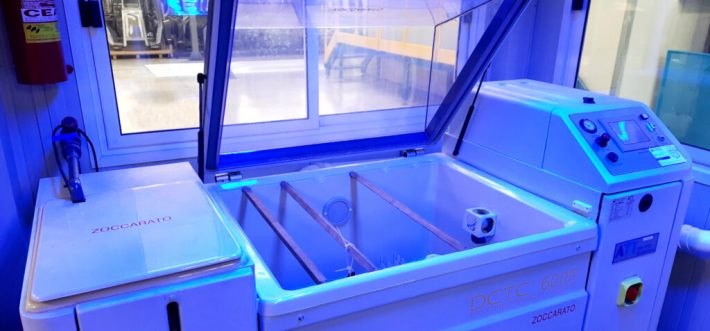
It is for this reason that carrying out preliminary tests can help to drastically reduce the unpredictability component linked to the duration and resistance of the painting of a product to certain atmospheric conditions and risk agents.
In this regard, one of the most carried out and reliable tests is called salt spray corrosion test (NSS, Neutral Salt Spray), or more simply salt spray test or accelerated aging test, and it is a process used in the quality control processes of painted materials and is regulated by precise European and international ISO regulations.
The reference standards for the correct execution of the test are ISO 9227:2017 and ASTM B117.

Salt spray tests are suitable for ensuring that the quality of a specific metallic material, with or without anti-corrosion protection, is maintained.
One of the major concerns of those who produce and deal with the quality control of materials is time and this specific type of test is very useful for simulating the real life cycle of a product in order to prove its deterioration in external environments. From an operational point of view, the salt spray test is carried out by inserting the material to be tested into a special chamber, where a saline solution (5% NaCl) is vaporised at a temperature of 35°C.
In this way the material in question undergoes the same (possible) alterations that it would undergo if exposed to air for a very long time, allowing the reactions to be verified quickly.
The times spent in the chamber vary depending on the test requested and, once completed, it will be able to give anyone who requests it a general picture of the corrosion performance of their product.
Do you want to receive more information? Contact us by writing to info@zoccaratoverniciature.it or calling 049 9202150.
More articles

E-coating or Powder Coating? 3 Factors to Consider Before Choosing
Why does metal corrode? The 7 factors not to be underestimated

Metal cabinets for data centers in a marine environment: why the C5-H cycle is fundamental

Cataphoresis: the questions you didn't know you had (and the answers that make the difference)
Have a project in mind?
Tell us about your needs: our team will guide you to the most suitable treatment.
Contact us