History of powder coating: from the mid-20th century to the present day
Contact usOver the years, powder coating has conquered the world, establishing itself as a quality standard in many industrial painting applications. Let's discover its history, from its origins in Germany in the late 1940s to the present day.
In the industrial sector, powder coating is now part of the collective imagination, having been the most widespread practice for many years and which guarantees the best relationship between quality of workmanship and final price.
Furthermore, technological evolution has allowed the creation of special automated booths for powder coating, making it possible to standardize the procedures for its use, sometimes assisted by human work in finishing the most particular details.
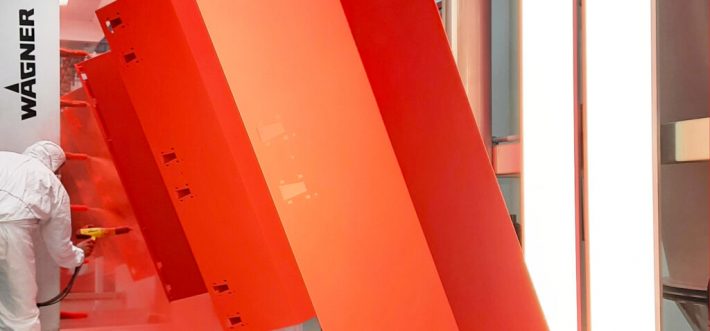
Compared to liquid painting, powder paints do not contain solvents and are applied to the articles using specially designed electrostatic guns; the powders are placed on the surfaces to be treated and subsequently, upon entering the oven, the paint polymerizes and settles definitively, transforming into a permanent layer.
But how did we get here?
The history of powder coating starts way back, in Germany in the late 1940s and early 1950s: environmental concerns relating to solvent contamination of liquid paints were beginning to cause concern and more sustainable alternatives to this now consolidated practice began to be evaluated.
Initially, the powders were flame sprayed onto metal surfaces, but in 1954 a patent was filed that would revolutionize the sector: the German scientist Erwin Gemmer developed the fluid bed treatment method for processing thermosetting powder paints. A significant step forward compared to flame spray, capable of greatly improving the quality of the workmanship.
Starting from Europe, the new method conquered the world: until the mid-60s the method developed by Dr. Gemmer was the most used for powder coating, whose applications concerned both aesthetics and functionality, for example in order to create surfaces resistant to corrosion and abrasion.
Given the excellent results obtained from powder coating, new methods were tested to raise the bar of quality and usability even higher: it was between 1962 and 1964 that the electrostatic processing of powder paint appeared on the market in the United States, applied using spray guns, and shortly thereafter exported to the rest of the world. The application was extremely familiar, as it closely resembled the existing use of liquid painting guns. The ease of use and convenience made it successful.
What was still missing was a sort of "standardization" of thermosetting resins, a way to precisely codify the raw material to be used: between the mid-60s and 70s the four main types of thermosetting resins were established: epoxy, hybrid epoxy-polyester, polyurethane and polyester. This allowed powder paints to be used in more widespread commercial settings, and the process took off.
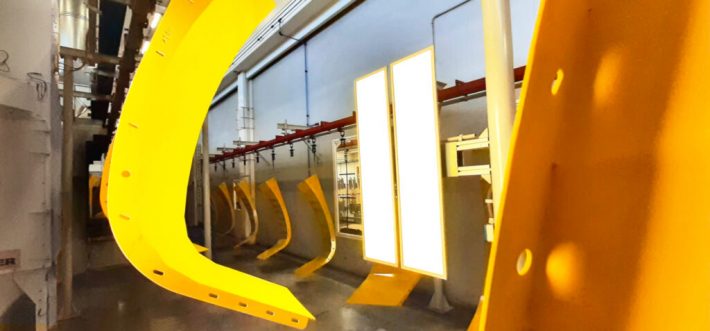
The rest is more recent history: between the 70s and 80s, powder coating became extremely widespread throughout North America, Europe and Japan, with the major global industries making use of it, understanding its potential.
Nowadays, improvements in application equipment have led to increased transfer efficiency, reduced waste and decreased overall costs. The recycling and reuse of unused powders also allows for greater environmental sustainability.
Furthermore, as anticipated, the introduction of advanced automatic booths means that the process can be standardized, making it perfectly assimilable into a modernly structured assembly line, so as to be able to accurately predict its operational potential and overall costs.
(In the video, the powder coating phase carried out inside one of our automatic booths, with the support of a specialized operator.)
More articles

E-coating or Powder Coating? 3 Factors to Consider Before Choosing
Why does metal corrode? The 7 factors not to be underestimated

Metal cabinets for data centers in a marine environment: why the C5-H cycle is fundamental
Cataphoresis: the questions you didn't know you had (and the answers that make the difference)
Have a project in mind?
Tell us about your needs: our team will guide you to the most suitable treatment.
Contact us