
Metal sandblasting: what it is and why it is important for painting
Contact usSandblasting is a term that has entered the common vocabulary: we know that it serves to remove imperfections from surfaces and that in most cases it is an intermediate process compared to a product manufacturing cycle, but how is it fundamental in the field of industrial painting?
When to use sandblasting?
Processing classes and degree of purity of sandblasting
In the field of industrial painting we often talk about the techniques that make up this material, therefore the various powder, liquid, cataphoresis or galvanizing coatings, just to give a few examples, but it often happens that we forget about that whole series of "complementary" practices that enrich and improve these main treatment phases.
It is expected that activities related to surface coatings will continue to increase over the years and for this reason it is increasingly important to know the steps that must be taken before applying a coating.
Sandblasting is an abrasive technique that advances the painting steps and helps prepare the surface of the materials to ensure that the coating can properly adhere to the substrate and provide a long-lasting finish. For this reason, sandblasting services are an essential part of the industrial painting process.
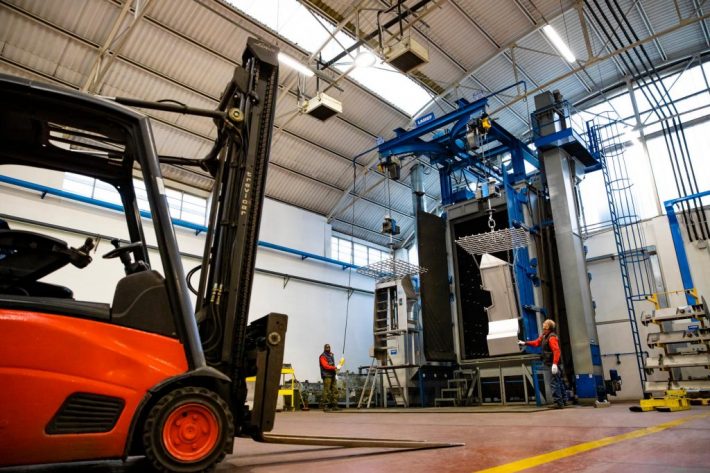
The sandblasting process
Sandblasting uses compressed air and particles of sand and/or other abrasive materials that hit the surface to be cleaned. If performed manually, these materials are expelled through a tube, if processed automatically, inside special tools called sandblasters, the articles are hit through a continuous jet inside a specially designed chamber, without human intervention.
When sand hits the surface of the material, the fine particles remove the top layer of rust, dirt and imperfections that would otherwise compromise the finish. This leaves a smooth, clean surface that can be worked with any coating needed. Sand is the most commonly used particulate; however, metal grit, glass beads and other various powdered abrasives can also be used to achieve an optimal finish.
Sandblasting is not always carried out for the sole purpose of improving painting performance; however, it should be remembered that this process is essential to ensure that both powder and liquid or cataphoresis coatings can adhere correctly to the surface of a material.
Without this step, and with an item compromised by dirt or rust, the life of the coating can be severely reduced and you can expect cracking, blistering and peeling due to poor adhesion.
The sandblasting method
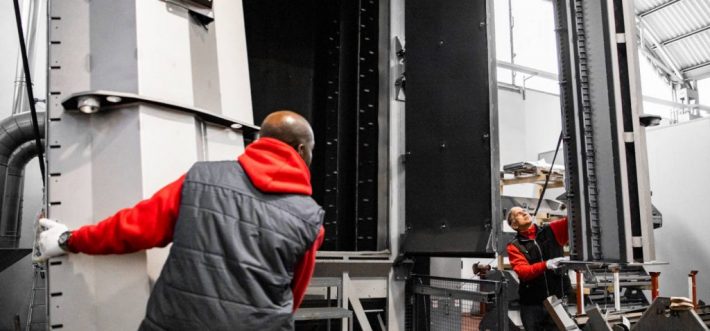
From a method point of view, the one applied within our systems is centrifugal mechanical sandblasting: the articles to be treated are inserted inside special cabins and hit by jets of abrasive material, obtained through the use of centrifugal turbines.
Among the salient characteristics of this method, the low use of labor and other automation of the process, a very high qualitative yield and the total absence of contamination due to the surrounding environment.
Ultimately, sandblasting is one of the most effective ways to clean or smooth a surface of any foreign material. It's similar to rubbing something with sandpaper, but provides a smoother surface, even in the nooks and crannies.
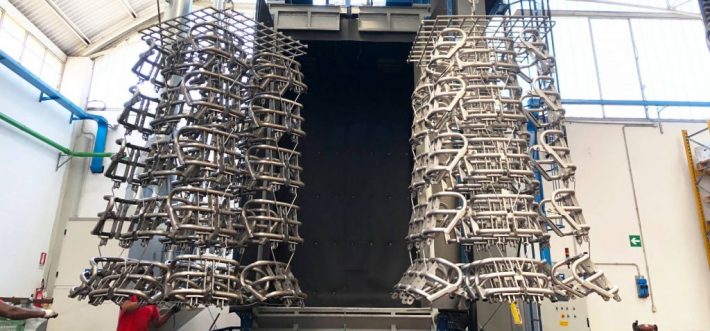
When to use sandblasting?
Sandblasting not only removes dirt, but also leaves imperceptible "scratches" which make the adhesion of surface coatings easier. In practice it modifies the surface roughness, eliminating the irregularities resulting from the upstream production processes. This gives a uniform and smooth appearance to the material to be painted, promoting the interaction between metal and polymer, improving the adhesion between substrate and paint and at the same time ensuring that the coating lasts as long as possible without peeling or cracking.
For this reason we consider sandblasting an essential service among those we offer to our customers: we improve the aesthetic performance and durability of the painting, all with automatic machinery that leaves no room for errors and inaccuracies.
Processing classes and degree of purity of sandblasting
There are 4 levels of surface cleanliness and purity, defined according to the Swedish Standard (SIS 05 5900 / ISO 8501-1:2012). Typically, a steel surface to be painted requires a purity of SA 2½ or SA 3.
1) SA 3 – white metal sandblasting
This involves the complete removal of impurities, dirt, scale, residues of any old paint, rust and products resulting from corrosion. This process results in a light gray metallic surface with a uniform appearance.
2) SA 2 1/2 – sandblasting to almost white metal
Levels immediately below SA 3, this grade refers to the complete removal of corrosion products, mill scale and traces of old paintwork, with the exception of light shading, graining or discolouration. 95% of the surface must be perfectly clean, while the remaining 5% must have the slight defects indicated above.
3) SA 2 – commercial sandblasting
With commercial sandblasting the gradation is lowered by a step, and a good but not perfect sandblasting is indicated: at least 2/3 of the surface must be free from calamine, rust, dirt and old paint, while the remaining 1/3 may have some residual impurities.
3) SA 1 – coarse sandblasting (or brushing)
It is a light sandblasting with which the detached lamination and rust flakes are removed, while the old paints and the lamination and rust flakes adhering to the substrate are left attached.
More articles

E-coating or Powder Coating? 3 Factors to Consider Before Choosing
Why does metal corrode? The 7 factors not to be underestimated

Metal cabinets for data centers in a marine environment: why the C5-H cycle is fundamental
Cataphoresis: the questions you didn't know you had (and the answers that make the difference)
Have a project in mind?
Tell us about your needs: our team will guide you to the most suitable treatment.
Contact us