
Phosphating: what it is, what it is for and why it is important for painting
Contact usPhosphating is a chemical pre-treatment that is applied to metals in order to protect them from corrosive agents. Let's see why it is essential for painting purposes and why we always recommend its use.
If you are wondering what phosphating is and why it is considered by many as an essential phase in the path that leads a metal article towards full protection from external agents, today we will try to answer your questions.
First of all, phosphating is a fundamental process for the success of an industrial painting treatment, and not only that. It is part of a broader process that leads to extending the useful life cycle of an asset and, ultimately, increasing its value over time.
First, we need to understand what it consists of and how it is implemented.
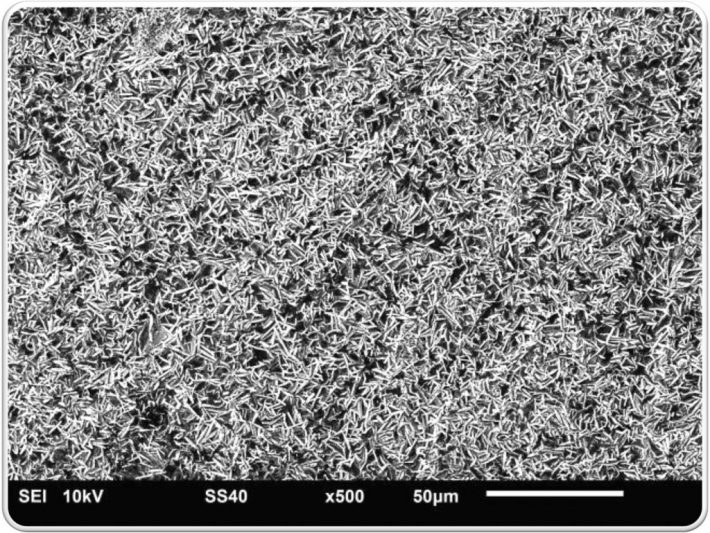
Surface analysis of a phosphated sheet metal, electronic/optical/SEM microscopy section – Magnification: Magnification x 500
What is phosphating
Phosphating is a chemical process characterized by the reaction between sulfuric acid and the metal surface, with subsequent deposition of the zinc layer, as a protective barrier against corrosion.
It can be applied on steel, iron, cast iron, aluminium, metal alloys and leads to the formation of a layer made up of insoluble phosphates which create a protective level from external agents. It is a chemical conversion, a process that leads to the modification of the chemical composition of the surface of a metal.
To obtain the best level of result, Zinc Salt Phosphating is present within our painting lines, with spray application.
The article to be treated is hit by a chemical solution applied via spray jet, composed of various elements, including:
Zinc phosphate;
Free phosphoric acid;
Accelerators, which have the purpose of speeding up the chemical reaction;
Other additives, such as manganese, calcium, fluorides, etc. Each of these additives makes a specific contribution, for example to make the surface crystalline grain finer and more compact in order to improve corrosion resistance.
Treatments prior to phosphating
Since the quality of the phosphate process is directly linked to the conditions of the surface that will be coated, it is necessary to prepare it in the best possible way.
This means that before starting the phosphating process, the metal articles must be perfectly clean: oils and greases, traces of oxidation, scale and various impurities due to sheet metal processing must be removed.
It is for this reason that the process is preceded by a series of phases, including:
Alkaline degreasing: a fundamental phase for surface cleaning of artefacts, from which fats, oils and impurities of various nature are removed; the effectiveness of our pre-treatment is even higher thanks to the immersion phase;
Activation: the phosphating phase is preceded by the activation phase, considered very important as it gives the metal surface properties favorable to the deposition of a microcrystalline and homogeneous phosphate layer.
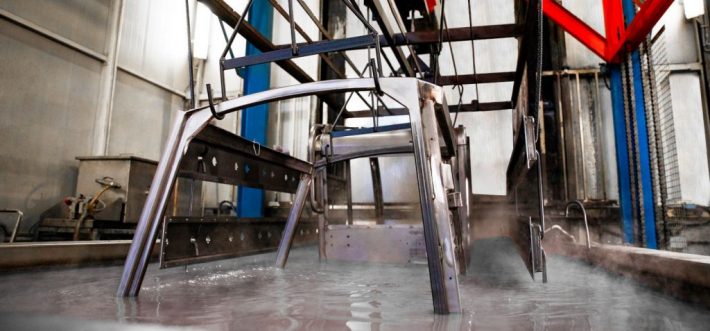
Phosphating is the main pre-painting anti-corrosion protection
There are a number of practical uses that make phosphating an extremely important process, including anti-corrosion protection through oiling, phosphating for cold forming of steels and lubrication to reduce friction between sliding surfaces, such as in the case of gears.
But the case that interests us most is the one linked to pre-painting: phosphating is the most widespread pre-treatment of metal surfaces in preparation for subsequent painting.
Painting must have particular properties to be considered qualitatively satisfactory: on the one hand mechanical, in reference to the adhesion between paint and substrate, on the other anti-corrosive, linked to resistance to oxidation and rust. Adhesion and its resistance, in addition to correct preparation of the support, are also influenced (but not only) by the thickness of the coating, while corrosion resistance is strongly correlated to the performance of the phosphating pre-treatment.
Phosphating is used when the article must collide with corrosive environments or agents that tend to impact the durability of the paint coating; for this reason it is widely used in demanding sectors such as automotive, agricultural and industrial machinery, fluid management solutions and household appliances.
Among the various existing types, currently the best performing one is the tricationic one, composed of zinc, nickel and manganese, because it is able to provide the best results both from a mechanical and anti-corrosion point of view, as well as giving the possibility of being applied both by immersion and by spraying. The result is excellent and the coating will be thin and well compacted.

An example of industrial application: the automotive sector
The aesthetic perfection and durability of the bodywork is fundamental: the bodies affect the first impact that people have with cars and the care with which they are made is well known.
Starting from this basic assumption, we understand the importance and role played by phosphating: in the automotive sector it is always used as a pre-treatment for painting, with the aim of making the surface as resistant as possible to the propagation of corrosion.
Precisely in order to make the bodywork as resistant as possible, a coating cycle in the automotive sector typically includes:
Phosphating;
Cataphoresis;
Primer;
Top coat.
It is worth remembering that zinc salt phosphating also improves the adhesion of paints, with a positive impact both in terms of resistance and aesthetic appearance.
Although it has been a consolidated standard for the automotive sector for a long time now, nowadays more and more industrial fields have introduced it as a safe method to increase the quality of the coating, the protection and ultimately the product to be treated.
More articles

E-coating or Powder Coating? 3 Factors to Consider Before Choosing
Why does metal corrode? The 7 factors not to be underestimated

Metal cabinets for data centers in a marine environment: why the C5-H cycle is fundamental
Cataphoresis: the questions you didn't know you had (and the answers that make the difference)
Have a project in mind?
Tell us about your needs: our team will guide you to the most suitable treatment.
Contact us