
Cataphoresis vs Nickel Plating, Chrome Plating and Burnishing: which solution to choose for the surface treatment of your products?
Contact usProtecting your products from corrosion and wear has never been more important. Discover the differences between cataphoresis, nickel plating, chrome plating and burnishing, and choose the best solution for your needs.
Choosing the best surface treatment for your products can be a complex operation. Among the available options, cataphoresis represents a very effective technology, but is often confused with other solutions, such as nickel plating, chrome plating and burnishing.

Cataphoresis: the electrochemical process that revolutionizes metal painting
Cataphoresis is an electrochemical coating process that allows you to protect metal surfaces from oxidation, corrosion and wear. This system uses a resin-based paint solution, which is deposited on the surface of the piece to be treated using an electric current. The final result is a uniform, resistant and low-thickness film, capable of guaranteeing high durability and excellent protection.
Unlike cataphoresis, nickel plating, chrome plating and burnishing represent more traditional and often less effective technologies.
Nickel plating involves the deposition of a layer of nickel on the surface of the piece, while chrome plating uses chrome to give a shiny and resistant appearance to the treated surface.
Burnishing, on the other hand, is a process that uses the oxidation of the metal to create a dark-colored patina, which makes the piece resistant to corrosion.
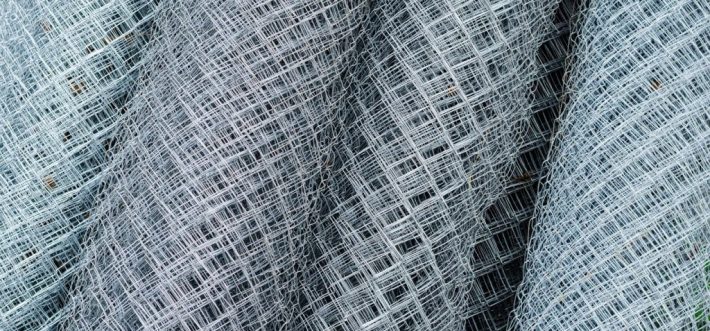
Nickel plating: how to protect metals from oxidation
Nickel plating is a surface coating process which involves the deposition of a layer of nickel on the surface of the piece to be treated. This process is often used to protect metallic materials from corrosion and wear.
Nickel plating can be achieved through various techniques, including electroplating, sponging, electrolytic immersion and plating. In any case, the process involves the use of a solution containing nickel ions, which are deposited on the surface of the piece to be treated through an electrodeposition process.
The final result of nickel plating is a uniform and resistant coating, capable of protecting the surface of the piece from corrosion, wear and radiation.
However, it should be considered that nickel plating also has some critical aspects, such as the possible environmental impact of electroplating processes and the risk of contact allergies, due to the possible presence of nickel in the coating of the finished products.
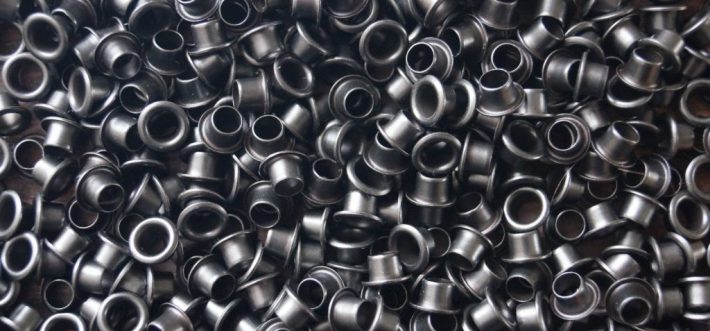
Everything you need to know about chrome plating
Chrome plating is a surface coating process which involves the deposition of a layer of chromium on the surface of the piece to be treated. This process is used to protect metallic materials from corrosion and wear.
The chrome plating process involves the use of an electrolyte containing chromium ions, which are deposited on the surface of the piece through an electrodeposition process. The chrome coating is very resistant and can protect the surface of the workpiece from corrosion, wear and abrasion.
However, as in the aforementioned case of nickel plating, chrome plating also presents some critical aspects, such as the high environmental impact of the electroplating processes and the risk of contact allergies, due to the possible presence of chromium in the finished products.

Burnishing: oxidation as a protective solution
Burnishing is a surface treatment process that involves the controlled oxidation of the surface of the piece to be treated to create a protective oxide layer. This oxide layer, called “burnishing,” is dark in color and can protect the surface of the part from corrosion and wear.
Burnishing can be achieved through various techniques, including immersion in iron salt solutions, nitrate burnishing and selenium burnishing. In any case, the process involves the use of chemical solutions that react with the surface of the piece to be treated to create a protective oxide layer.
Bluing is often used to protect the metal surfaces of mechanical parts, tools, firearms and other objects that require greater resistance to corrosion and wear. Furthermore, from an aesthetic point of view, this treatment gives the articles a characteristic dark appearance.
However, it should be considered that burnishing has some limitations in terms of resistance and durability, compared to other surface coating processes such as cataphoresis, chrome plating or nickel plating. Additionally, burnishing can be affected by environmental factors such as exposure to light, humidity and air, which can cause the coating to degrade over time.

Differences between cataphoresis, nickel plating, chrome plating and burnishing
But what are the main differences between these technologies and cataphoresis? First of all, cataphoresis guarantees a uniform coating, which covers even the most complex parts of the piece. Furthermore, the paint used in cataphoresis has significantly superior anti-corrosive properties compared to nickel and chromium, which can become dull or yellow over time.
In summary, here are the main differences between cataphoresis, chrome plating, nickel plating and burnishing:
Cataphoresis is an electrochemical coating process that uses a conductive paint solution to deposit a uniform layer of paint on the surface of the part, while chrome plating, nickel plating and burnishing use chemical electrodeposition processes to deposit metals or oxides on the surface of the part.
Chrome plating involves the deposition of a layer of chromium on the surface of the piece, while nickel plating involves the deposition of a layer of nickel on the surface of the piece. Burnishing, on the other hand, creates a dark-colored oxide layer on the metal surface.
Cataphoresis, chrome plating and nickel plating are very resistant and long-lasting processes, capable of protecting the surface of the piece from wear and corrosion. Burnishing, on the other hand, has lower resistance than the metal coating processes listed above.
Cataphoresis and chrome plating are processes also used to improve the aesthetic appearance of the piece, while nickel plating and burnishing are mainly used for protection against corrosion and wear.
Chrome plating, nickel plating and burnishing have a higher environmental impact than cataphoresis, which uses epoxy resins instead of metals in its coating.
Below is a list of the results obtained in our laboratory regarding the comparative salt spray tests:
Cataphoresis: 500 hours in salt spray.
Nickel plating: 240 hours in salt spray.
Chrome plating: 240 hours in salt spray.
Burnishing: 50 hours in salt spray.
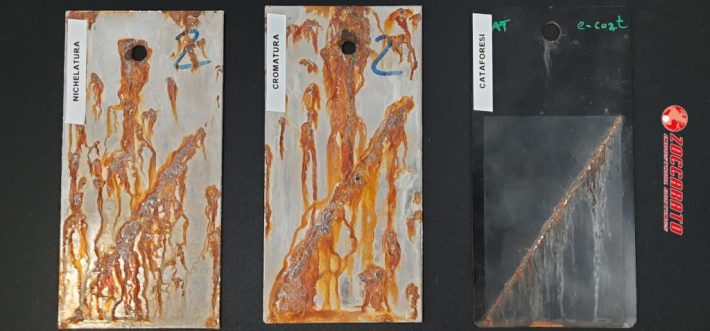
Tested in salt spray in our laboratory, these nickel-plated, chromed and cataphoresis-treated sheets clearly show how cataphoresis leads to significantly greater resistance to corrosion.
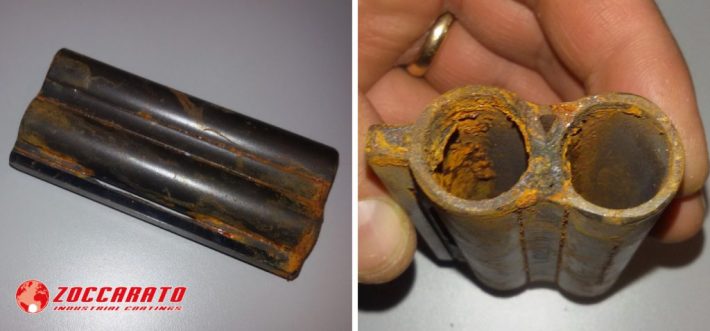
Salt spray test carried out on a burnished article. The test was carried out in our laboratory.
Conclusions
In summary, if you are looking for an effective solution to protect your products, cataphoresis is an ideal choice. Thanks to its ability to cover even the most difficult parts of the product and its very high resistance to corrosion, cataphoresis represents the most advanced and high-performance surface treatment available on the market among the four examined.
More articles

E-coating or Powder Coating? 3 Factors to Consider Before Choosing

Why does metal corrode? The 7 factors not to be underestimated

Metal cabinets for data centers in a marine environment: why the C5-H cycle is fundamental

Cataphoresis: the questions you didn't know you had (and the answers that make the difference)
Have a project in mind?
Tell us about your needs: our team will guide you to the most suitable treatment.
Contact us